
Somerset County Court Records After Arrest
Somerset County criminal cases move through Pennsylvania's magisterial district judge and Common Pleas structure. The county is the 16th Judicial District. After an arrest, the early steps often include police processing, possible booking at Somerset County Jail, preliminary arraignment, bail review, and a preliminary hearing. If charges are held for court or waived, the case moves to Common Pleas, where the prosecutor files the information and the case can proceed to formal arraignment, pretrial conference, plea, trial, sentencing, or appeal.
The court record is not the same as a jail custody entry. Somerset County does not publish a county-hosted jail roster, so custody checks start with PA SAVIN/VINE and the jail officer station. The formal charges, docket events, and dispositions are found through court sources instead. For custody and booking context, use Somerset County jail inmate records. For booking photo questions, use Somerset County jail mugshots. A docket can show that a charge was filed after an arrest, but it does not prove conviction unless the disposition says so.
Find Court Records After Jail Arrest
The main public lookup path is Pennsylvania UJS Case Search. It searches public docket information from Common Pleas, magisterial district courts, appellate courts, and other indexed courts. For Somerset County court records after a jail arrest, useful searches include participant name, docket number, OTN, complaint number, incident number, county, judicial district, MDJ office, docket type, and case status.
The UJS Case Search interface includes several search modes for post-arrest court records.
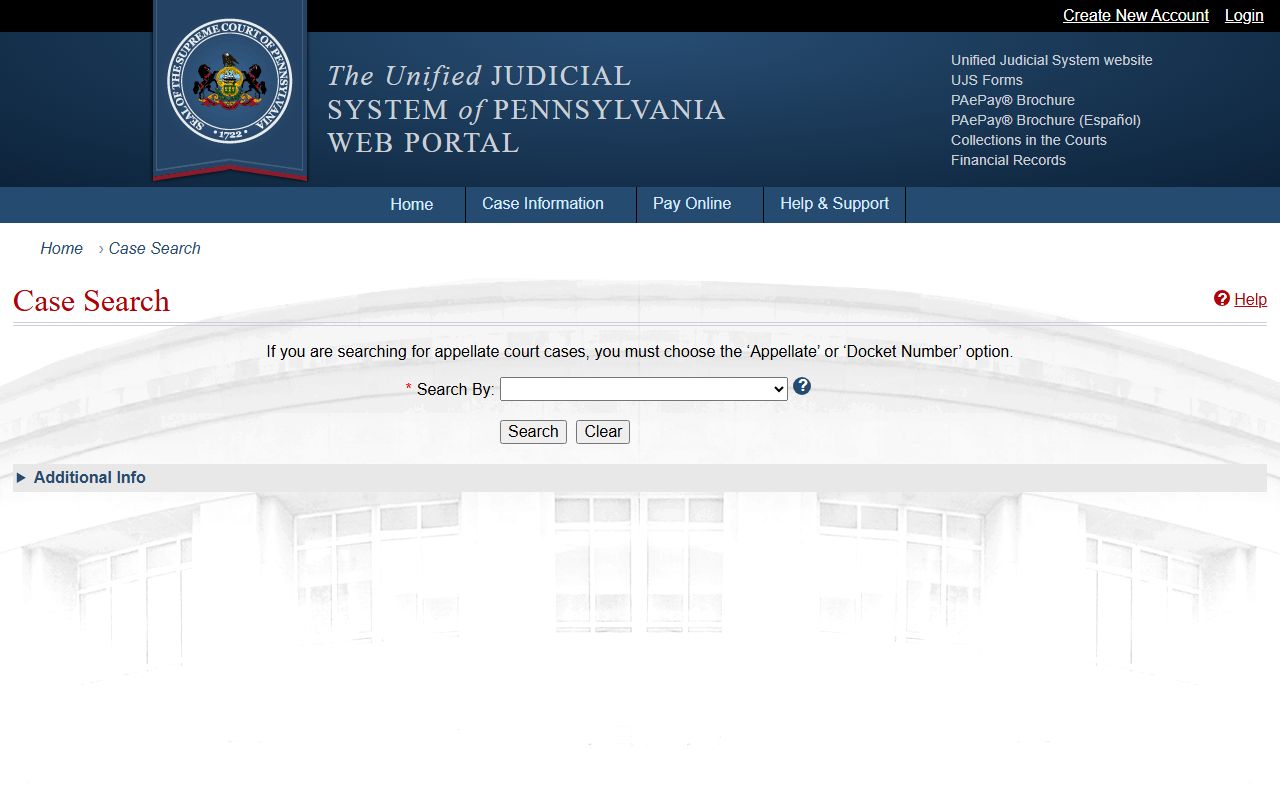
Use the search fields that match the information from the arrest or summons. If the case is new, try both the defendant name and the OTN from paperwork, then narrow by Somerset County or Judicial District 16.
| Field Label | Type | Required | Options / Format Notes |
|---|---|---|---|
| Search mode | Tab, radio, or list | Yes | Includes docket, OTN, complaint, incident, participant name, citation, date filed, calendar, and SID searches. |
| Docket Number | Text | Search-dependent | Use the Common Pleas or MDJ docket number when known. |
| OTN | Text | Search-dependent | Offense tracking number tied to Pennsylvania criminal records. |
| Participant Name | Text | Search-dependent | Last name is the main field; first name helps narrow common names. |
| County / Judicial District | Dropdown | Optional | Select Somerset or Somerset - 16 to narrow the court records after arrest. |
| MDJS Court Office | Dropdown | Optional | Somerset MDJ offices include 16-3-01, 16-3-02, 16-3-03, 16-3-05, and 16-3-06. |
| Docket Type / Status | Dropdown | Optional | Criminal, summary appeal, traffic, active, closed, inactive, and other options may appear. |
Somerset County Charging Records
Charging records explain why a court case exists after an arrest. In Pennsylvania, the early criminal complaint often starts at the magisterial district court level. At preliminary arraignment, the defendant is advised of the charges and rights, bail is addressed, and a preliminary-hearing date is set. At the preliminary hearing, the Commonwealth must show a prima facie case, meaning enough proof for the charge to move forward at that early stage.
Somerset County District Attorney Tom Leiden's office is the county prosecutor. County DA materials state that the office prosecutes criminal-law violations, handles criminal appeals and victim services, advises law enforcement, and reviews certain search-warrant and arrest-warrant applications in serious cases.
| Document | Who Uses It | What It Means After Arrest |
|---|---|---|
| Complaint | Police and MDJ court process | Starts many cases and lists the first allegations after arrest or summons. |
| Information | District Attorney in Common Pleas | Formal prosecutor-filed document after charges are held for court or waived. |
| Indictment | Grand jury process when used | Formal accusation from a grand jury, less common in routine county cases. |
Court Charge Status After Arrest
Charge status can change between arrest, booking, preliminary hearing, Common Pleas filing, and final disposition. Arrest or booking language may reflect the police allegation at intake. The District Attorney may approve, amend, reduce, add, or decline charges after review. The court docket is the stronger public source for filed charges, docket events, dispositions, and sentencing because it follows the case through the MDJ and Common Pleas systems.
| Status | Plain Meaning | How to Read It |
|---|---|---|
| Pending | The charge is still open. | Check the next hearing, bail entry, and court level before drawing conclusions. |
| Held for court | The MDJ found enough proof for the case to move forward. | The case can move to Common Pleas, where an information may be filed. |
| Amended or reduced | The filed charge changed. | Compare the original complaint with the current docket charge list. |
| Dismissed or withdrawn | The charge did not continue in that form. | Other counts may remain, so review each count separately. |
| Nolle prosequi | The Commonwealth declines to proceed on that charge. | This is a prosecutor action, not a conviction. |
| Guilty plea or verdict | The case reached a conviction on that count. | Read the sentence and disposition date for the final court result. |
Bail Records After Somerset Arrest
Bail and release entries are part of the court pathway after a jail arrest. Pennsylvania Rule of Criminal Procedure 520 requires bail before verdict where the law allows it, and refusal of bail must be stated in writing or on the record. Rules 523, 524, and 528 cover release criteria, recognizance, nonmonetary conditions, unsecured bail, nominal bail, monetary bail, and reasonableness.
Somerset County's Intermediate Punishment Plan describes a local Bond Supervision Program for defendants released on bail and monitored for court appearances and bail-bond conditions. A bail entry on the docket does not always mean release is complete. Holds, detainers, probation or parole warrants, federal custody, U.S. Marshals issues, or ICE detainers can keep a person in custody even when a local bail amount appears payable.
The PAePay Bail portal is a statewide payment and search tool, but Somerset County participation was not confirmed in the extracted subscribed-court information. PAePay also cautions that online payment may not be available in every county or docket type, sureties may still need to contact the court or prison to finish documents, and online payment timing does not guarantee prompt release.
Warrants and Court Records After Arrest
Somerset County does not appear to publish a simple official public warrant-search database. The Sheriff's Office executes orders and warrants issued by judges, including arrests and searches under court authority. The DA Office Responsibilities page says county detectives maintain active bench-warrant lists and coordinate fugitive arrests and extraditions. UJS dockets can show bench warrants, bail actions, and court events, but UJS is not a complete active-warrant list.
Use care if a warrant may exist. Search UJS by participant name, docket number, OTN, complaint number, or incident number. Then contact counsel, the issuing court office, or the Sheriff's Office for surrender and bail instructions. The custody system becomes relevant only after booking.
Charge vs Conviction Records
A charge is an accusation filed in court after an arrest. A conviction is the result of a guilty plea, guilty verdict, or other conviction entry on a specific count. Public docket records may show both, and the distinction matters. A person can be booked, charged, released, and later have one count dismissed while another count remains pending. A custody notice or booking record does not prove guilt.
| Record Point | Charge | Conviction |
|---|---|---|
| Stage | Accusation after arrest or summons. | Final or partial case outcome on a count. |
| Source | Complaint, information, docket charge list. | Docket disposition, plea, verdict, and sentencing entry. |
| Proof level | Early process may involve probable cause or prima facie review. | Requires plea or proof beyond a reasonable doubt at trial. |
| Public meaning | Shows what was alleged. | Shows what was admitted or found by the court. |
Sealed Court Records After Arrest
Pennsylvania public access law has several layers. The Right-to-Know Law presumes agency records are public unless an exemption, privilege, court order, other law, or nonpublic status applies. The Criminal History Record Information Act, often called CHRIA, governs criminal-history definitions, dissemination, access, expungement, and limited access.
| Record Treatment | Sealed or Limited Access | Expunged |
|---|---|---|
| Public view | Restricted from public dissemination for qualifying records. | Removed under an expungement order. |
| Common basis | Clean Slate or CHRIA rules for eligible records. | Qualifying nonconvictions, acquittals, pardons, age/death provisions, or summary cases. |
| Effect | Some agencies may still have limited lawful access. | Records are treated as removed from public access as ordered. |
| Practical step | Review the docket and CHRIA eligibility before assuming public access is blocked. | Confirm that the expungement order reached the agencies that hold the record. |
Juvenile records, sealed records, expunged records, limited-access records, and active investigative material can affect what appears in public court records after an arrest. The Pennsylvania State Police PATCH service is the official criminal-history background-check route.
Somerset Court Records Contacts
Local contacts depend on the record. The Clerk of Courts is the criminal-record custodian for Somerset County court records. The District Attorney prosecutes cases and handles victim services. Magisterial district judge offices handle preliminary arraignments, preliminary hearings, and early criminal proceedings.
District Attorney
111 East Union Street, Suite 30
Somerset, PA 15501
814-445-1456
Victim Service Department: 814-445-1459
Clerk of Courts
Somerset County criminal-record custodian
Somerset County Courthouse
814-445-1435
Maintains criminal filings, minute books, jury records, costs, fines, and CPCMS records.
MDJ Offices
16-3-01 Boswell: 814-629-9775
16-3-02 Windber: 814-467-5113
16-3-03 Somerset: 814-445-1535
16-3-05 Rockwood: 814-445-7442
16-3-06 Meyersdale: 814-634-0614
County Open Records
Chief Clerk
300 North Center Ave, Suite 500
Somerset, PA 15501
rtk@somersetcountypa.gov
Fax: 814-445-7991
For records not posted online, the Somerset County Open Records page gives the county Right-to-Know submission path. The Pennsylvania Office of Open Records explains state response and appeal rules.